I have a small tattoo. It is on my upper right back, not immediately visible, not large. I knew going into our Japan trips that this was something I needed to think about at onsen facilities, but I did not fully understand the landscape until we started going.
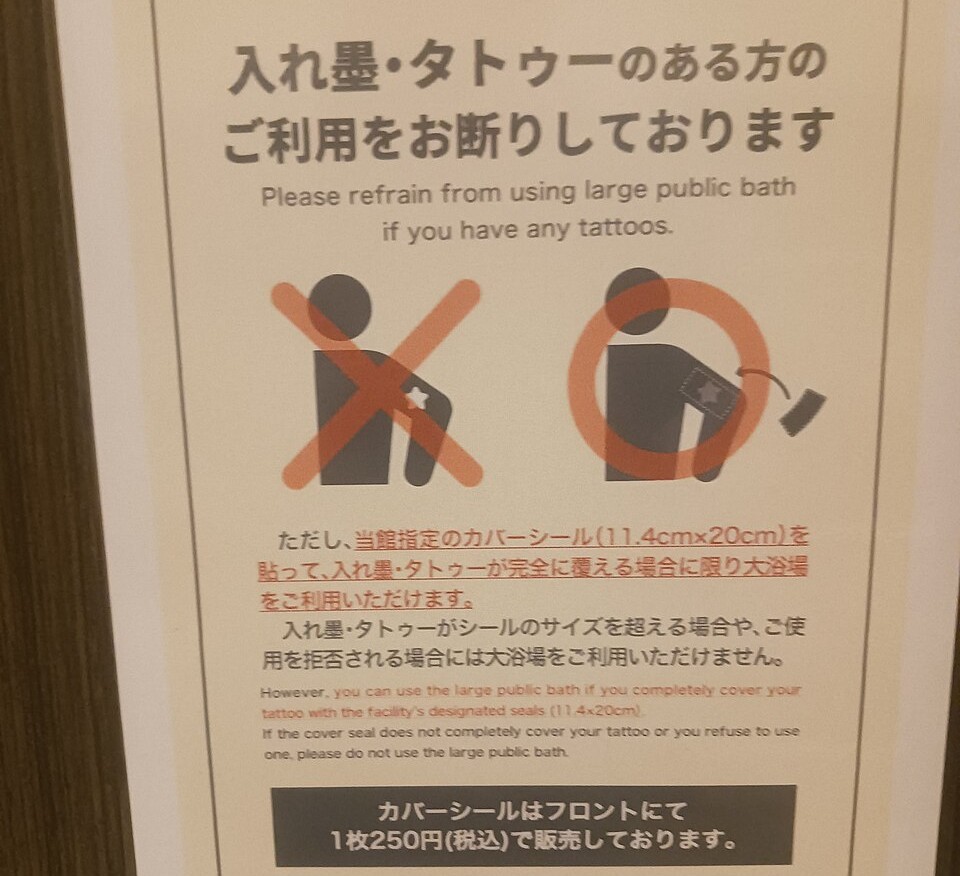
The first time a staff member noticed was at a facility in Hokkaido. She came over quietly, gestured toward my back, and produced a small skin-coloured cover patch from her pocket. She mimed placing it. She smiled throughout the entire interaction. It was genuinely one of the most graceful customer service moments I have experienced in any country. I covered it. I went in. The soak was excellent.
That experience set the tone for how I approach this now. The policy exists. Most facilities that have it will enforce it professionally and kindly. The key is simply knowing in advance so you are not surprised at the entrance.
Here is what I have learned across multiple trips.
Why the policy exists
Japan's tattoo prohibition at onsen dates to the Meiji era, when tattooing was associated with the yakuza, organised crime syndicates whose members traditionally used body tattoos as identity markers. The association between visible tattoos and criminal organisation became embedded in the culture of shared bathing spaces, which are environments built around trust and community.
That association has been shifting for decades. International tourism, the visibility of tattooed athletes at the 2021 Tokyo Olympics, and changing attitudes among younger Japanese people have all moved things forward. But the shift is gradual and uneven, and the policy still exists in a significant number of facilities, particularly the large resort bathhouses that were built during an era when the prohibition was standard.
Understanding the reason matters because it changes how you think about the situation. This is not about aesthetics or personal judgment. It is a policy with a specific historical origin that is slowly changing, and engaging with it respectfully produces much better outcomes than confrontation.
The three categories you will encounter
After visiting a lot of onsen across Japan, the landscape breaks down into three groups.
The first group openly welcomes tattoos. A growing number of facilities have explicitly updated their policies to allow tattooed guests. Hyotan Onsen in Beppu, which we visited on our 2025 Kyushu trip, is in this category. Hyotan holds three Michelin Stars and serves an international clientele. Their position is that tattoos are not their concern. You walk in, the staff are professional, the focus is on the extraordinary variety of baths. The hot sand sunamushi bath there was something I had never experienced anywhere else. You are buried in geothermally heated black sand by an attendant in a yukata and left to warm gently while staring up at the sky.
Kusatsu Onsen's public baths are also tattoo-friendly. As is the free community bathing tradition at Nozawa Onsen. Jigokudani Onsen in Nagano, where the snow monkey park is located, allows tattoos. The old Korakukan ryokan there has a deliberately traditional and inclusive character.
The second group has a discretionary or varies policy. This category is larger than either of the clear-cut groups. Many facilities, particularly smaller family-run inns and rural onsen, handle the situation case by case. They may have a house rule technically prohibiting tattoos but in practice they deal with each guest individually, especially foreign visitors.
Our approach at any facility where the policy is unclear: Ryan asks in Japanese, politely and directly, before we check in. His conversational Japanese has been one of the most practical things about our trips. The conversation is almost always brief and productive. Facilities that are flexible will say so. Facilities that enforce the policy will say so. Either way, we know what we are walking into.
Noboribetsu Onsen falls in this category. Several of the facilities there have moved to a more flexible position, while the largest resort bathhouses still have the prohibition. You need to check the specific facility, not just the town. Hakone is similar, with dozens of facilities at varying positions.
The third group maintains a formal prohibition. Large resort bathhouses, particularly those that serve domestic group tours as their primary market, are the most likely to maintain formal restrictions. Dai-ichi Takimotokan in Noboribetsu, which is extraordinary with 35 pools across multiple floors drawing from seven spring types, prohibits tattoos in the shared baths. This was the case when we visited and they were clear and polite about it.
For facilities in this category the options are a private bath, where the prohibition often does not apply, or a cover patch. Both work. Private baths at Japanese ryokan are frequently excellent, sometimes a wooden tub on your own balcony overlooking forest or a river, with the same spring water piped in.
What actually works
Based on all of this, here is the practical approach.
Check before you go, not at the door. SpringsAtlas lists the tattoo policy for every spring in the database. Filter by ALLOWED or VARIES before you build your itinerary. The listing page shows the policy prominently.
If the policy is unclear, ask in advance. A phone call or email before arrival removes all uncertainty. Most facilities appreciate it. Ryan's Japanese made this easy for us, but a simple written message via Google Translate works well. Japanese onsen staff are generally experienced with international guests.
Carry a cover patch. For facilities where you will use a cover patch, you can buy flesh-coloured waterproof covers at Japanese pharmacies for a few hundred yen. Having your own means you are not relying on the facility's supply and you can choose a size that actually works for your tattoo.
Do not argue. If a facility says the policy applies and you disagree with it, the right move is to find a different facility. There are enough excellent tattoo-friendly onsen in Japan now that there is no need to spend energy on a negotiation that was never going to go well.
Regions and specific recommendations
Kyushu is probably the most tattoo-friendly region in Japan for onsen. Beppu in particular has embraced international tourism and many of its facilities have updated their policies accordingly. Hyotan Onsen is the standout. Nagayu Onsen in the mountains of Oita Prefecture is also welcoming, and the carbonated waters there are extraordinary, fine bubbles forming across your skin like nothing else in Japan.
Tohoku has a mixed landscape. The small community baths in Aomori and the rural inns we visited during our week there were generally flexible and practical about foreign visitors with tattoos. Sukayu Onsen in the Hakkoda mountains was one of our best experiences of the entire 2025 trip and they handled the situation gracefully.
Hokkaido is split. Resort facilities in Noboribetsu tend to maintain formal policies. Smaller facilities around Jozankei and Asahidake are more flexible. The remote springs such as Futamata Onsen and Ofuka Onsen are so removed from the resort circuit that the question essentially does not arise.
Greater Tokyo and Kansai are the areas where you will most commonly encounter formal prohibitions at the larger, more commercially developed facilities. The smaller neighbourhood sento public baths in city areas tend to be more pragmatic.
The shifting landscape
Japan's onsen tattoo policy has been changing visibly and will continue to change. The Japan Tourism Agency has been encouraging facilities to update their approach for nearly a decade. A survey in 2023 found that over 30 percent of onsen facilities had changed their policy in the previous five years, almost all in the direction of greater acceptance.
If you visited Japan five years ago and were turned away somewhere because of a tattoo, the same facility may have a different position today. It is worth checking the current status rather than assuming the old experience still applies.
The SpringsAtlas database marks each spring's policy and we update listings when we learn of changes. If you visit a spring and find the policy is different from what is listed, the Report Issue link on every listing page sends it directly to us.
The goal is to make the practical information available so that travellers can spend their time soaking rather than navigating unexpected surprises at the door. Japan's hot springs are genuinely extraordinary. The tattoo question is solvable. It should not be the thing that defines your experience.