
Hungary
Széchenyi, Gellért or Rudas? Choosing Your First Budapest Thermal Bath
I spend part of every summer in Rome with my father's side of the family. Last year I finally did the thing I had been putting off. I took the short flight over to Budapest with two cousins and gave myself three days to answer one question. Why does everyone call this the City of Spas?
The answer is under the city. Budapest sits on a fault line where more than a hundred thermal springs push mineral water up through the limestone. Romans bathed here. Ottomans built dome-covered pools here in the 1500s that are still in use. The Hungarians then turned bathing into a civic institution, the way Italians treat the piazza. If you only have time for one bath, the hard part is choosing. So here is the honest comparison I wish I had before landing.
The big three at a glance
| Széchenyi | Gellért | Rudas | |
|---|---|---|---|
| Built | 1913 | 1918 | 1566 |
| Style | Neo-Baroque palace | Art Nouveau | Ottoman dome |
| Star feature | Outdoor pools with chess players | Stained glass and Zsolnay tiles | Rooftop tub over the Danube |
| Crowd | Tourists and locals, lively | Quieter, more elegant | Mixed, traditional on weekdays |
| Best for | First-timers, atmosphere | Architecture lovers | History and views |
All three are covered in detail in our directory, with temperatures, pH, entrance fees, and how to get there: Széchenyi, Gellért, and Rudas.
Széchenyi: the postcard
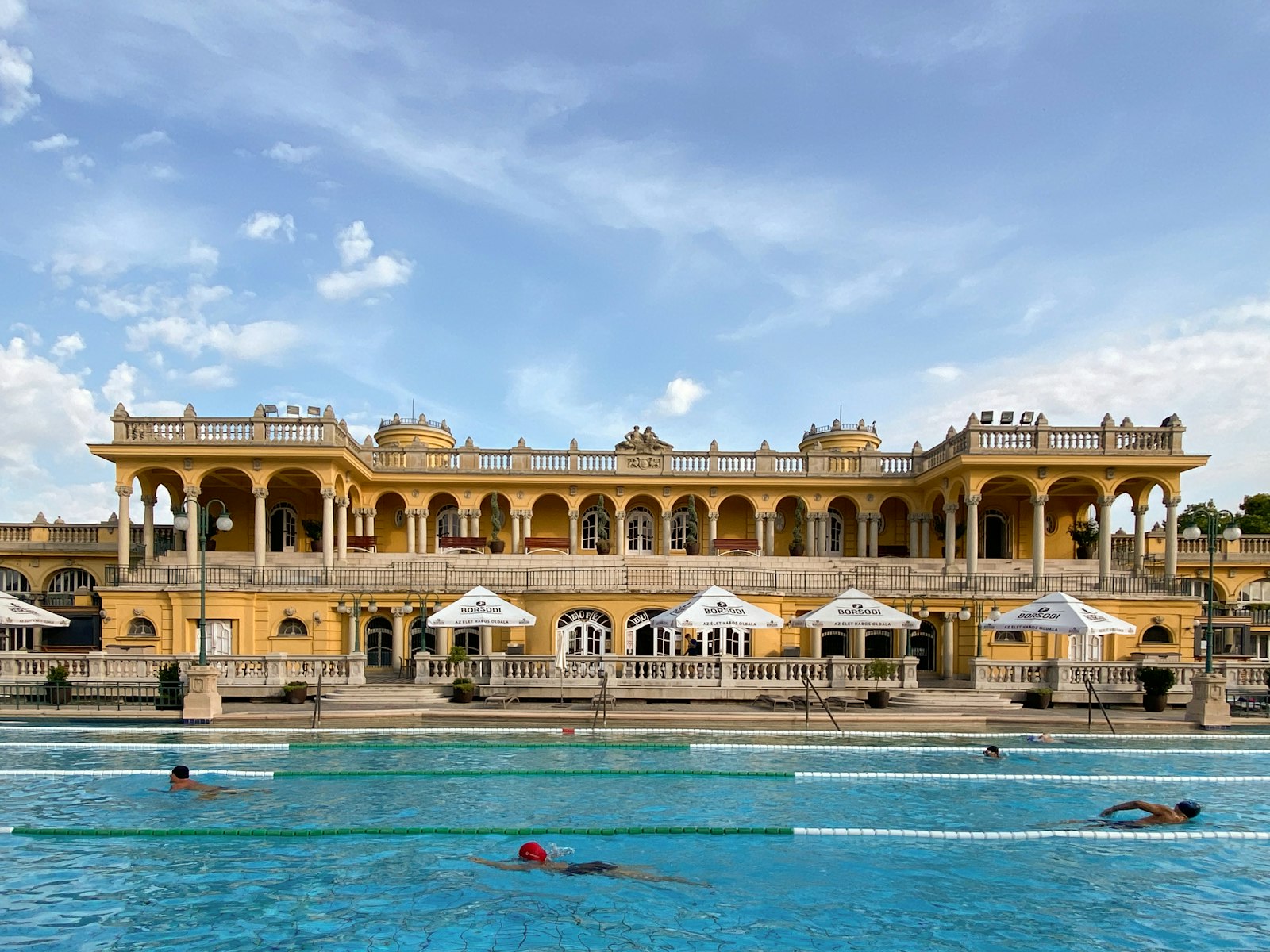
Széchenyi is the one you have seen in photos. A huge ochre-yellow palace in City Park with steam rising off outdoor pools, and older Hungarian men playing chess on floating boards in the middle of the water. That scene is real and it happens every single day, all year, even in snow.
The outdoor thermal pools sit around 38 degrees, which means you can stay in for a long time without overheating. Inside, the building is a maze of smaller pools at different temperatures, and working through them slowly is the whole point. Nobody rushes here.
My hospitality-student observation: Széchenyi handles enormous volume with a system that looks chaotic and works anyway. Buy your ticket online the night before, go right at opening, and you get an almost private palace for one hour before the tour groups arrive around ten.
Gellért: the beautiful one
Gellért is attached to the famous hotel of the same name, and walking into the entrance hall feels like walking into a cathedral built for water. Marble columns, a stained-glass roof, and pools lined with deep blue and gold Zsolnay porcelain tiles.
The water is gentler here than at the sulfur-heavy baths, and the indoor halls echo in a way that makes everyone speak quietly. In summer the outdoor wave pool switches on its 1927 machinery and turns a calm soak into a gentle sea, which sounds like a gimmick and is actually delightful.
If you care about design, this is your bath. I spent almost as much time looking up at ceilings as I spent in the water. Book a private cabin instead of a locker. It costs a little more and gives you a small changing room of your own, which matters when the main hall gets busy.
Rudas: the time machine
Rudas is the oldest of the three by a wide margin. The core of the building is an octagonal pool under a stone dome built in 1566, during the Ottoman occupation. Light comes down through small star-shaped holes in the dome and lands on the steam. It does not feel like a spa. It feels like a place of worship that happens to be full of warm water.
Two things to know before you go. First, the historic Turkish section still runs single-sex days on weekdays, alternating men and women, with mixed bathing on weekends. Check the schedule before you plan your visit. Second, the modern wing has a rooftop hot tub with a glass wall that looks straight across the Danube at Pest. Go at dusk on a Friday or Saturday, when Rudas runs night bathing and the city lights come on while you soak.
The practical stuff nobody tells you
Bring flip-flops. The stone and tile floors are wet everywhere and rental options are inconsistent.
Bring your own towel, or accept the rental line. At Széchenyi especially, the towel queue at midday can be longer than the entry queue.
Swim caps are only required in the dedicated lap-swimming pools, never in the thermal pools. If you are not swimming laps, you do not need one.
Cabins beat lockers at every bath if the price difference is small that day. A cabin is a private changing room that locks. A locker is a locker.
Tattoos are a non-issue in Hungary. Coming from writing about Asian hot springs, where tattoo policy is a whole topic, Budapest is refreshingly indifferent.
Every bath charges in forint and posted prices usually mean weekday prices. Weekends cost a little more.
So which one first?
If it is your first time in Budapest, go to Széchenyi. It is the full spectacle, it is the easiest to reach on the little yellow M1 metro line, and the outdoor pools in the morning steam are the single best introduction to why this city loves its water.
If you have two days, add Rudas at night. The jump from a 1913 palace to a 1566 Ottoman dome, in one trip, is the history of European bathing in two tickets.
Gellért is the one I would take my mother to. Slower, prettier, quieter. Save it for a morning when you are not in a hurry.
And if you fall for the thermal water the way I did, the rest of Hungary is full of it. There is a swimmable thermal lake at Hévíz, another Ottoman bath in Eger, and the largest spa complex in Europe at Hajdúszoboszló. Browse the whole country in the SpringsAtlas Hungary directory.

SpringsAtlas may earn a commission, at no extra cost to you.
Sources and further reading
- Budapest Gyógyfürdői és Hévizei (Budapest Spas cPlc), official operator pages for Széchenyi, Gellért, and Rudas: schedules, prices, and single-sex day calendars
- Hungarian Tourism Agency, thermal and medicinal tourism overview
- SpringsAtlas Hungary directory listings, with verified temperature, pH, and fee data per bath
Matteo Esposito is a Filipino-Italian Hospitality and Luxury Management student at De La Salle College of Saint Benilde. Born in Rome and raised in Manila, he writes about Indonesian hot springs from first-hand travels across Bali and Java, with a foodie's eye for the whole experience.