Indonesia has more volcanoes than almost anywhere on earth, and where there are volcanoes there is hot water bubbling up somewhere nearby. The country is quietly full of hot springs, from manicured resorts to wild riverbeds, and most visitors walk right past them on the way to a beach.
I came to them as a complete beginner on a trip to Bali and Java, and I made a few rookie mistakes so you do not have to. Here is the orientation I wish I had before my first soak.
The springs come in very different flavors
Not all Indonesian hot springs are the same, and knowing the type tells you what kind of day you are signing up for.
There are the resort springs, like Ciater near Bandung or Toya Bungkah on Lake Batur, which are developed, ticketed, and built for comfort, often with multiple pools and food on site. There are the rustic natural springs, like Angseri in Bali, where you walk down into a valley to reach simple pools by a waterfall. There are the geothermal oddities, like Cisolok in West Java, which is the only natural geyser in the country, where you bathe in a warm river next to vents that shoot boiling water into the air. And there are the highland springs, like Guci on Mount Slamet or the pools up on the freezing Dieng Plateau, where the appeal is hot water against genuinely cold mountain air.
What the water is actually like
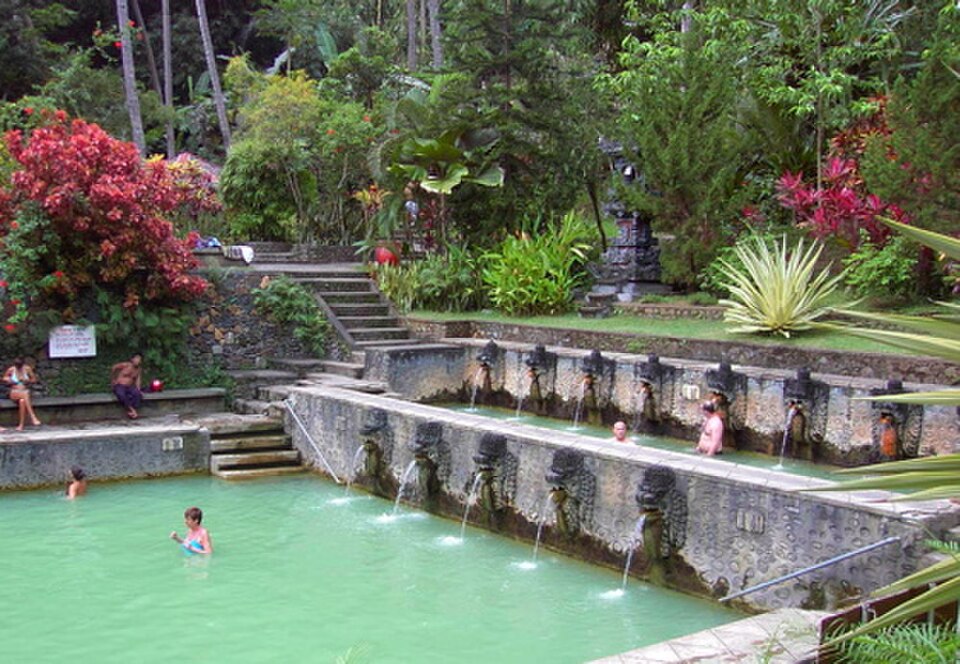
Most of these springs are volcanic and sulfurous, which means two things. First, that faint rotten-egg smell is normal and not a sign anything is wrong. Second, the minerals can stain. At places like Banjar in North Bali the water is a cloudy yellow-green and will absolutely discolor a white swimsuit, so wear something dark. Some springs are gentler and almost odorless, like Cipanas in Garut, which is the easy, family-friendly end of the spectrum.
A few springs run hot enough to hurt, and at Cisolok the geyser vents are genuinely dangerous. The rule there is simple. Never wade up to the spouts. Find the spot downstream where the boiling water has already mixed with the cool river, and soak there.
The packing checklist I now never skip
After a couple of fumbled visits, this is what I bring every single time.
Wear your swimwear under your clothes so you are not hunting for a changing room when you arrive. Pack a plastic bag for the wet swimwear afterward. Bring a full change of dry clothes and underwear, because sitting through lunch in a damp waistband is its own punishment. Carry sunscreen and sunglasses, because the open-air pools catch the full sun by mid-morning. And keep cash in rupiah on hand, since lockers, towel deposits, and private cabanas almost always want small local notes rather than a card.
A bit of etiquette
These are mostly public, family places, so modest swimwear is the norm rather than anything skimpy. Rinse off at the freshwater showers before you get into the communal pools, do not use soap or shampoo in the shared water, and keep your voice down at the quieter natural springs where people came specifically to escape the noise.
Religion and dress: this matters more than you think
Here is the thing that surprised me most as a first-timer. Indonesia is not culturally uniform, and what you wear and how you behave at a spring depends a lot on where you are. The country is the largest Muslim-majority nation in the world, but Bali is a Hindu island, and that difference shapes the etiquette directly.
On Java, which is predominantly Muslim and more conservative, the local norm at a hot spring is to stay covered. Most Indonesians soak in shorts and a t-shirt rather than revealing swimwear, and women often bathe fully clothed or in modest swimwear. As a visitor you will not be forced into anything, but turning up in a skimpy bikini at a family pool in Garut or Pacet reads as tone-deaf. Loose clothing that covers the shoulders and knees is the respectful default, and it doubles as sun protection in the open-air pools.
On Bali the atmosphere at the recreational hot springs is more relaxed, and ordinary swimwear is generally fine at developed spots like Toya Bungkah and Banjar. Even so, modest is still the safe choice, and a sarong is genuinely useful to have, both for covering up between pools and because you will need one constantly elsewhere on the island.
Here is how the springs in our directory break down.
| Region | Springs | Predominant culture | Dress guidance |
|---|
| West Java | 4 | Muslim | Cover shoulders and knees, soak in shorts and a shirt |
| Central Java | 2 | Muslim | Conservative, modest swimwear or clothed |
| East Java | 2 | Muslim | Cover shoulders and knees, modest swimwear |
| Bali | 3 | Hindu | Ordinary swimwear fine, carry a sarong |
Sacred springs are a different thing entirely
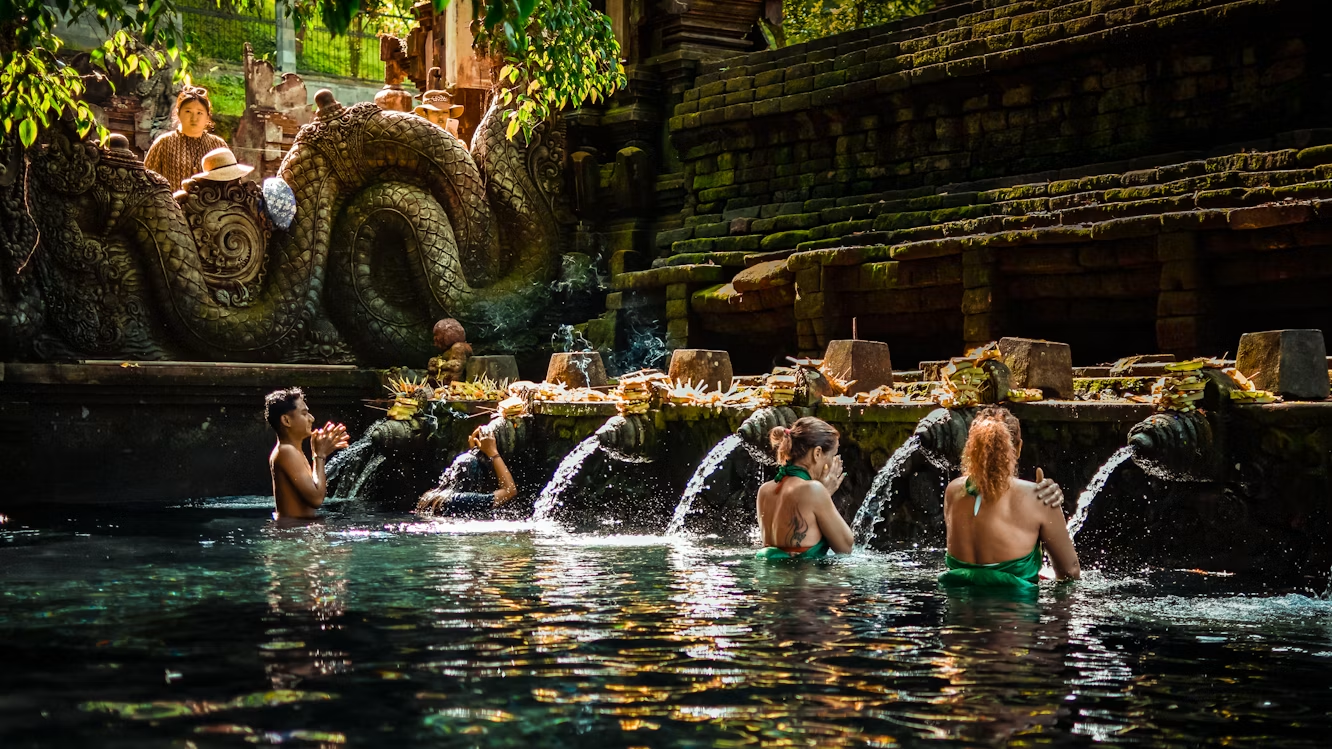
One crucial distinction. Many travelers searching for Bali hot springs actually end up at a holy water temple like Tirta Empul near Ubud, and these are not recreational baths at all. They are active Hindu purification sites, where worshippers perform the melukat cleansing ritual under a row of sacred spouts.
If you visit one, the rules are strict and non-negotiable. You wear a specific green sarong and sash provided at the site, never your own, and only over modest clothing. You do not wear sunscreen or lotion, because it pollutes the holy water. You receive water and make offerings with your right hand, since the left is considered impure. Women who are menstruating are asked not to enter the water. And it is a place of worship, not a swimming pool, so you move through it quietly and respectfully.
The simple rule of thumb: if a spring is attached to a temple and people are praying in it, it is sacred, treat it as worship. If it is a geothermal pool at a resort or in a forest, it is recreational, treat it as a bath. The springs in this guide are all the recreational kind, but it is worth knowing the difference before you go.


SpringsAtlas may earn a commission, at no extra cost to you.
Where to start
If it is your very first time, I would point you at an easy resort spring first, somewhere like Ciater or Cipanas where everything is set up for you. Once you have the rhythm, go find a wild one. The walk down into Angseri or the post-hike soak at Toya Bungkah are the visits I still think about, and they are the reason I now treat hot springs as a reason to travel rather than a footnote.