
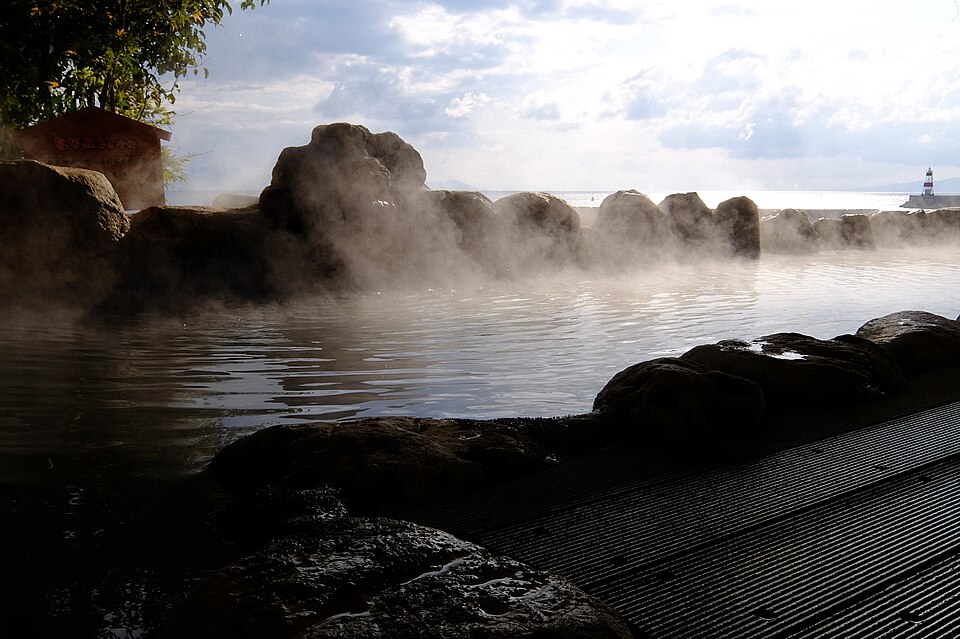
Shimabara Onsen
島原温泉
4.3 · 1858 reviews · via Google
Shimabara Onsen
sodium-chloride · Kyushu
Hotter than 18% of Japan springs (n=122).
More acidic than 41% of Japan springs (n=121).
Mineral profile
Bar width reflects listing order, not measured concentration.
Suitability
At a glance
Getting there
Easy — under 1km from a station
Cost
Low
Crowd level
Moderate
About this spring
Shimabara Onsen occupies the eastern coast of the Shimabara Peninsula in Nagasaki Prefecture, a historic spa town commonly called the City of Water. More than 60 spring sites together produce roughly 220,000 tonnes of water per day, and that water moves openly along stone-lined channels running through the streets. The 1624 Shimabara Castle rises above the town, and the surrounding terrain reflects the influence of Mount Unzen, an active volcano that defines the character of the region.
Highlights
History
Shimabara Castle was built between 1618 and 1625, giving the settlement its foundation as a castle town.
The feudal lord Matsukura Shigemasa then moved against the local Christian population, and that persecution contributed to the Shimabara Rebellion of 1637 to 1638, which ranks among the most consequential uprisings of the Edo period. In 1653, a later lord formally recognized the area as an onsen town and imposed a prohibition on hunting near the springs. A catastrophic volcanic collapse in 1792 killed an estimated 15,000 people and permanently transformed the city's underground hydrology, producing the exceptional spring output the town is known for today. In 1967, a centralized management system was installed to pipe hot spring water throughout the city.
Local guide
Getting to Shimabara requires a particular kind of patience. From Nagasaki, you take the JR line to Isahaya Station, then transfer to the private Shimabara Railway, which rattles east across the peninsula for about ninety minutes with Mount Unzen visible most of the way. The volcano is not dormant in the casual sense. It has erupted destructively within living memory, most recently in 1991, and the scorched hillside zones above the town are still visible from the train window. You arrive at Shimabara Station with that context already established.
What the town looks like, though, comes as a surprise. Over sixty natural spring sites produce roughly 220,000 tonnes of fresh water every day, and much of that water runs openly through channels along the city streets. The Shinmachi district, a short walk from the castle, has narrow canals with colored carp swimming through them, fed by spring water filtered through the volcanic layers of Unzen. The water is soft and visually clear, rich in sodium bicarbonate, which gives it a faintly sweet character and a slickness against the skin. Locally it is called bijin-yu, beauty water. The bath temperature runs between 38 and 45 degrees, comfortable enough for long soaks.
Shimabara Castle, the white-walled fortress built in 1624, rises above the town and connects it to one of the most violent episodes in Japanese history. The heavy taxation imposed to fund the castle's construction, combined with persecution of Christians in the region, set off the Shimabara Rebellion of 1637, a massive peasant uprising that ended in massacre at Hara Castle to the south. Three restored samurai houses stand in the Teppo-machi district along a small canal street near the castle walls, and they are open to the public without any theatrical presentation. Just three old houses by the water.
The most striking detail at Shimabara is also the simplest one. At Shimeiso Spring Garden, a preserved villa built directly over the spring sources, you can sit on the tatami floor with tea and look out at a pond where enormous koi move through water so clear you can see every scale. The spring water underneath the building keeps the pond at a constant temperature year-round. The carp have been here longer than most of the guests. It is the kind of place that takes about ten minutes to see and about a week to stop thinking about.
Mineral chemistry
Water character inferred from mineral type — verify on site.
Sodium chloride springs, essentially natural saltwater baths, are celebrated for their warming and moisturising effects. The salt forms a thin film on the skin that slows moisture evaporation, keeping skin hydrated longer than a freshwater bath.
Those with high blood pressure or heart conditions should consult a doctor before bathing, as the warming effect increases circulation. Avoid immersing open wounds.
Similar springs
 FREE
FREEThe valley occupies the center of Noboribetsu Onsen in Hokkaido. Jigokudani translates as Hell Valley. The crater covers 11 hectares and releases roughly 10,000 tonnes of hot spring water each day. Fumaroles vent steam across the floor of the valley, boiling pools bubble at the surface, and the surrounding cliffs carry heavy mineral staining. A walking path winds through the area in about 20 minutes and is open to all visitors at no cost. It ranks among the most striking landscapes accessible on foot anywhere in Japan.

Beppu is the most geothermally active city in Japan, with more than 2,900 hot spring vents located within the city limits and eight distinct thermal spring zones collectively known as the Beppu Hatto. The variety on offer is wide, ranging from grand hotel bathhouses to modest neighborhood public facilities to the celebrated Hells, a collection of brilliantly colored boiling pools scattered across the city. The Hells run far too hot for bathing, but they draw visitors who come to walk among them and take in the spectacle.

Arima Onsen sits in the hills above Kobe, close to Mount Rokko, and ranks among the oldest hot spring towns in Japan. The town draws visitors for two entirely different spring types that coexist within its compact footprint. Kinsen is the iron-rich golden water that stains surrounding rocks a rusty orange, while ginsen runs clear and carries both carbonation and mild radioactivity. Few other onsen destinations in Japan bring together two such distinct water types within a single small town.

Tsuru-no-yu is the oldest of the seven inns at Nyuto, set deep in a beech forest in Akita Prefecture. The main draw is a large outdoor mixed-bathing pool fed by opaque, milky-white sulfurous water. Many regard it as the most beautiful onsen setting in Japan. People come here to put some distance between themselves and the rest of the world for a while.
Amenities
Getting there
Take the Nishi-Kyushu Shinkansen to Isahaya Station, then transfer to the Shimabara Railway for about 70 minutes to Shimabara Station. Visitors from Kumamoto can also take a passenger ferry from Kumamoto Port to Shimabara Port in about 30 minutes.
Location & nearby
2-chōme-7331-1 Bentenmachi, Shimabara, Nagasaki 855-0802
Make a day of it
Pair your soak with these nearby spots.
Park
Shimabara ReiokakōEn
0.2km away
Park
ShimabarakaihinkōEn
0.2km away
Park
MisogorōKōEn
0.2km away
Park
SankaifureaikōEn
0.2km away
Attraction
HamanogawayūSui
0.3km away
Park
ReiokakōEn
0.4km away
More springs in Kyushu
Beppu is the most geothermally active city in Japan, with more than 2,900 hot spring vents located within the city limits and eight distinct thermal spring zones collectively known as the Beppu Hatto. The variety on offer is wide, ranging from grand hotel bathhouses to modest neighborhood public facilities to the celebrated Hells, a collection of brilliantly colored boiling pools scattered across the city. The Hells run far too hot for bathing, but they draw visitors who come to walk among them and take in the spectacle.
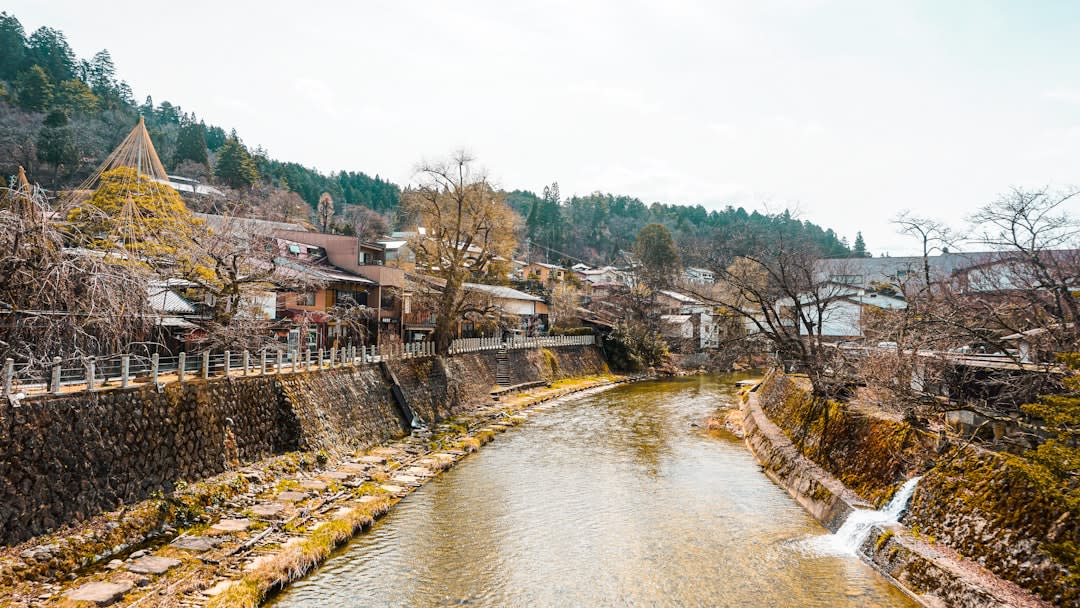
A peaceful artsy onsen town at the foot of Mt. Yufu in Oita Prefecture. The town is known for boutique galleries, craft shops, and ryokan with private outdoor baths. Lake Kinrin sits at the heart of it all. On quiet mornings, steam rises off the lake's surface in a way that seems almost designed to make you stop and stand still.
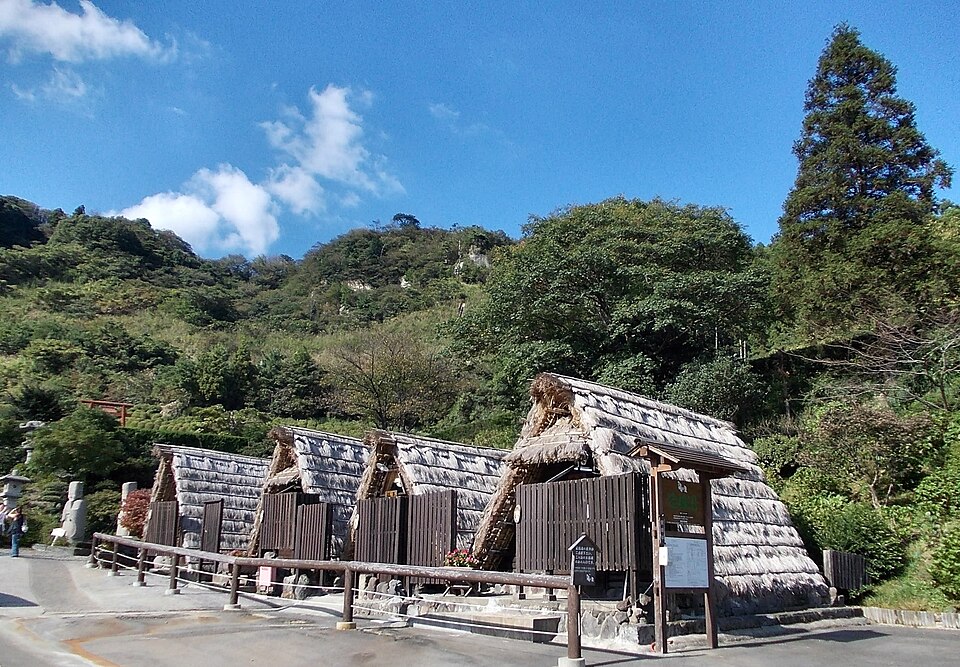
Set on a wooded slope in Beppu's Myoban district, this resort draws visitors for its yunohana, a term meaning hot spring flowers, which are white crystalline deposits that collect on surfaces where steam from the springs cools and condenses. The spring water itself is strongly sulfurous and acidic, rising at high temperatures from one of the eight volcanic source zones that make up Beppu Hatto.
Common questions
What is the water temperature at Shimabara Onsen?▾
The water temperature at Shimabara Onsen ranges up to 45°C (minimum around 38°C).
Is Shimabara Onsen free to visit?▾
Shimabara Onsen charges an entrance fee in JPY.
Is Shimabara Onsen a public or private bath?▾
Shimabara Onsen is a public bathing spring.
Are tattoos allowed at Shimabara Onsen?▾
No, Shimabara Onsen does not permit visible tattoos.