
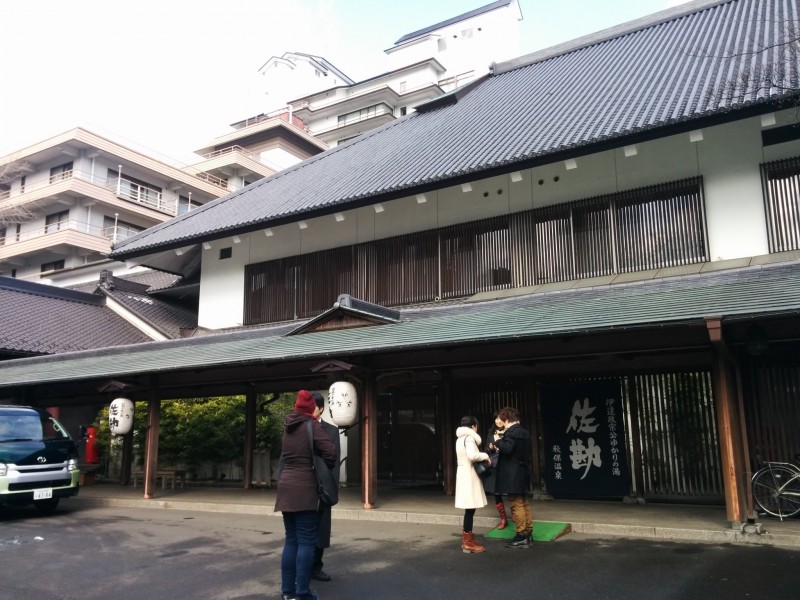
Sakan Onsen
佐勘温泉
4.2 · 2288 reviews · via Google
Sakan Onsen
sodium-chloride · Tohoku
Hotter than 20% of Japan springs (n=122).
More acidic than 50% of Japan springs (n=121).
Mineral profile
Bar width reflects listing order, not measured concentration.
Suitability
At a glance
Getting there
Easy — under 1km from a station
Cost
High
Crowd level
Popular
About this spring
Hotel Sakan sits within the Akiu Onsen resort in Miyagi Prefecture, one of Japan's three ancient imperial hot springs. The inn has remained in continuous operation under the same family line for 34 generations, a span of more than 800 years. The spring water is classified as a sodium sulfate type, and tradition holds that Emperor Kinmei once bathed here to recuperate from illness. On the property stands a sacred flame that is said to have been burning without interruption for 400 years, brought originally from Mount Koya.
Highlights
History
The waters at Akiu Onsen have been in use for more than 1,500 years.
The visit of Emperor Kinmei for convalescence is what earned the spring its place among Japan's Three Great Hot Springs. The site is referenced in classical literature, appearing in both the Yamato Monogatari and the Shuishu poetry anthology. During the Edo period, the lord of Sendai, Date Masamune, chose Akiu as his private bathing ground. Hotel Sakan was established more than 800 years ago and has remained in the hands of a single family across 34 generations.
Local guide
About thirty minutes south of Sendai, the main road follows the Natori River upstream into a narrow valley where the cedar slopes crowd close on both sides. The city noise disappears completely before you reach Akiu Onsen, and the last stretch of road runs so close to the river that you can hear it through a closed car window. Sakan sits right at the edge of that water, a large traditional inn whose oldest sections have been standing here for over a thousand years, run by the same family across thirty-four generations. You arrive to the sound of the Natori rushing below the windows.
The spring water is a sodium chloride type, clear and colorless in the bath, with a clean, faintly salty taste if any gets on your lips. It comes out hot and stays that way, coating your skin in a thin mineral film that you can feel when you step out and the air hits you. There is no sulfur smell, no cloudiness, just honest, dense salt water that leaves your joints feeling loose and your skin faintly warm for a long time afterward. The baths facing the river are the ones to seek out, where you can watch the green water below churning over the boulders while steam rises around you.
The history here runs deeper than most visitors realize. Emperor Kinmei is said to have recovered from illness after bathing in these waters roughly 1,500 years ago, which earned Akiu a place among Japan's Three Great Imperial Hot Springs alongside Shinano and Inukai. That designation is not just a marketing line. It explains why this valley was considered worth preserving long before anyone thought of building a resort road. The flame that burns in the property's inner shrine is said to have been lit by a priest from Mount Koya and has not been extinguished for four centuries.
The best moment at Sakan is early morning, before other guests are awake, when you can take one of the riverside outdoor baths completely alone. The Natori runs fast after any rain, and if you get there in the right season, you will hear the water and little else. There is no performance happening here, no theatrical ryokan ritual for tourists. The place simply carries on the way it has for a very long time, with the water coming up from the same ground and the same family keeping the doors open. That continuity is what gives it weight.
Mineral chemistry
Water character inferred from mineral type — verify on site.
Sodium chloride springs, essentially natural saltwater baths, are celebrated for their warming and moisturising effects. The salt forms a thin film on the skin that slows moisture evaporation, keeping skin hydrated longer than a freshwater bath.
Those with high blood pressure or heart conditions should consult a doctor before bathing, as the warming effect increases circulation. Avoid immersing open wounds.
Similar springs
 FREE
FREEThe valley occupies the center of Noboribetsu Onsen in Hokkaido. Jigokudani translates as Hell Valley. The crater covers 11 hectares and releases roughly 10,000 tonnes of hot spring water each day. Fumaroles vent steam across the floor of the valley, boiling pools bubble at the surface, and the surrounding cliffs carry heavy mineral staining. A walking path winds through the area in about 20 minutes and is open to all visitors at no cost. It ranks among the most striking landscapes accessible on foot anywhere in Japan.

Beppu is the most geothermally active city in Japan, with more than 2,900 hot spring vents located within the city limits and eight distinct thermal spring zones collectively known as the Beppu Hatto. The variety on offer is wide, ranging from grand hotel bathhouses to modest neighborhood public facilities to the celebrated Hells, a collection of brilliantly colored boiling pools scattered across the city. The Hells run far too hot for bathing, but they draw visitors who come to walk among them and take in the spectacle.

Arima Onsen sits in the hills above Kobe, close to Mount Rokko, and ranks among the oldest hot spring towns in Japan. The town draws visitors for two entirely different spring types that coexist within its compact footprint. Kinsen is the iron-rich golden water that stains surrounding rocks a rusty orange, while ginsen runs clear and carries both carbonation and mild radioactivity. Few other onsen destinations in Japan bring together two such distinct water types within a single small town.

Tsuru-no-yu is the oldest of the seven inns at Nyuto, set deep in a beech forest in Akita Prefecture. The main draw is a large outdoor mixed-bathing pool fed by opaque, milky-white sulfurous water. Many regard it as the most beautiful onsen setting in Japan. People come here to put some distance between themselves and the rest of the world for a while.
Amenities
Getting there
From Sendai Station, board a Miyagi Kotsu bus from the West Exit Bus Terminal toward Akiu Onsen. The ride to the Sakan-mae stop takes about 40-50 minutes. Buses run more than once per hour throughout the day.
Location & nearby
Yakushi-28 Akiumachi Yumoto, Taihaku Ward, Sendai, Miyagi 982-0241
Make a day of it
Pair your soak with these nearby spots.
Attraction
AkihoonsenkyōDōYokujō
0.1km away
Attraction
Iwanumaya
0.2km away
Attraction
Saryo Soen
0.4km away
Park
AkihorizōTo・ShinrinsupōTsukōEn
0.4km away
Park
AkihoshinrinsupōTsukōEn
0.4km away
Attraction
Akihoonsen
0.6km away
More springs in Tohoku

Set deep in the Hakkoda Mountains of Aomori Prefecture, Sukayu Onsen is a historic bathhouse best known for its cavernous mixed-bathing hall, the Sen-nin-buro, which translates as the Bath of a Thousand Bathers. The waters are strongly acidic, the setting is rustic and unhurried, and winter brings extraordinary snowfall to the surrounding mountains.
Tsuru-no-yu is the oldest of the seven inns at Nyuto, set deep in a beech forest in Akita Prefecture. The main draw is a large outdoor mixed-bathing pool fed by opaque, milky-white sulfurous water. Many regard it as the most beautiful onsen setting in Japan. People come here to put some distance between themselves and the rest of the world for a while.
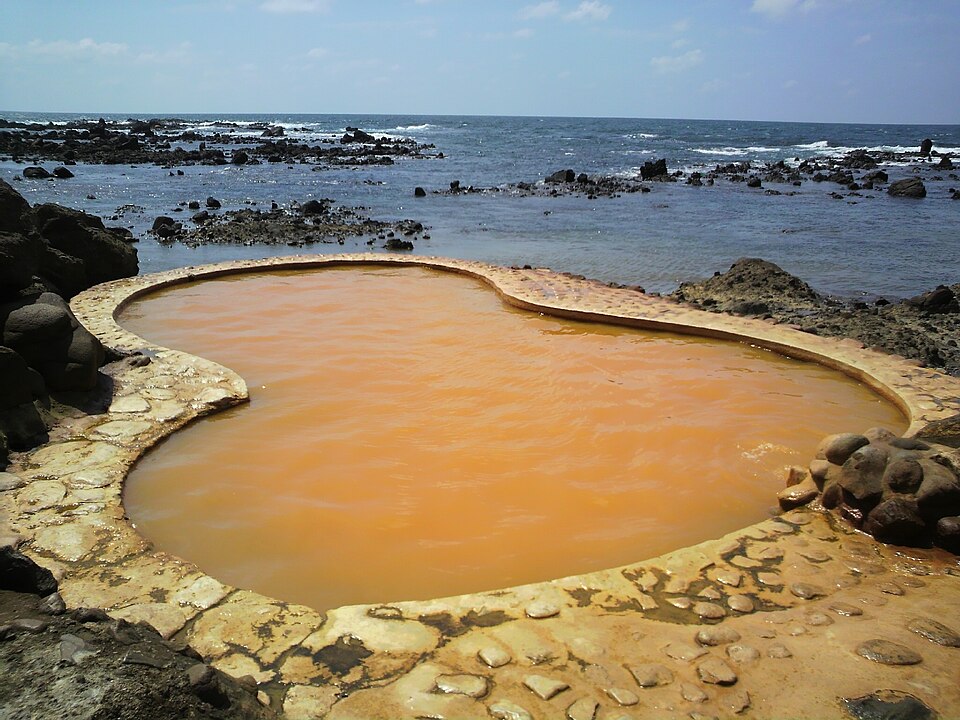
Furofushi Onsen occupies a rocky cape in Fukaura, Aomori Prefecture, with outdoor bathing pools positioned at the edge of the Sea of Japan cliffs. The spring water runs a deep reddish-brown from its high iron and sodium chloride content. The main open-air bath and a dedicated women's pool both use fully undiluted water drawn straight from the source. Sunsets over the water are a particular draw. Once day visitors depart in the late afternoon, overnight guests have the pools to themselves.
Common questions
What is the water temperature at Sakan Onsen?▾
The water temperature at Sakan Onsen ranges up to 46°C (minimum around 44°C).
Is Sakan Onsen free to visit?▾
Sakan Onsen charges an entrance fee in JPY.
Is Sakan Onsen a public or private bath?▾
Sakan Onsen is a public bathing spring.
Are tattoos allowed at Sakan Onsen?▾
Tattoo policy varies at Sakan Onsen. Check ahead of your visit.
What is the nearest station to Sakan Onsen?▾
The nearest station to Sakan Onsen is Sakan Mae, about 0km away.