
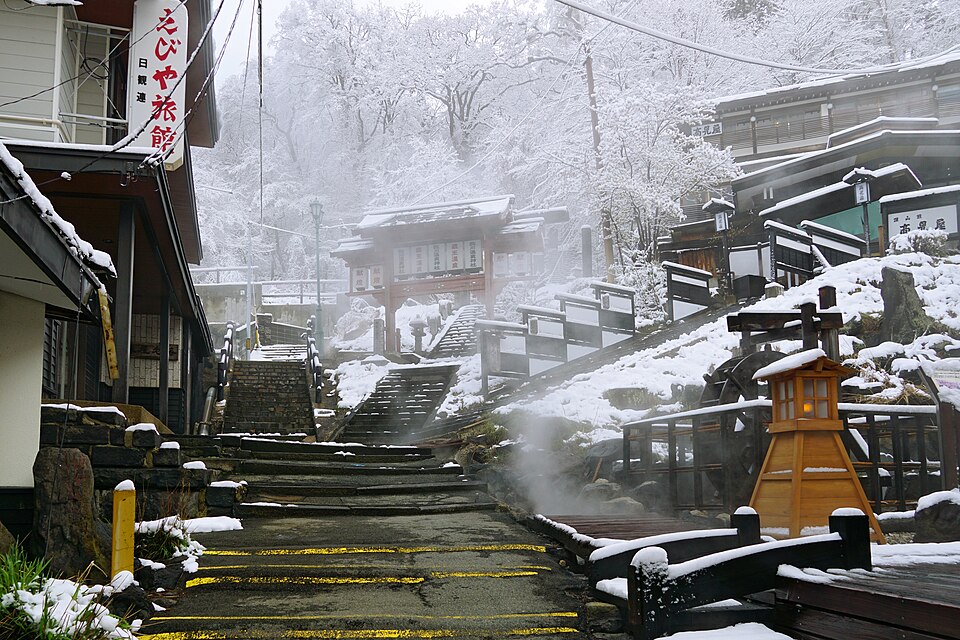
Zao Onsen
蔵王温泉
4.3 · 1900 reviews · via Google
Zao Onsen
sulfur · Tohoku
Hotter than 90% of Japan springs (n=122).
More acidic than 4% of Japan springs (n=121).
Mineral profile
Bar width reflects listing order, not measured concentration.
Suitability
At a glance
Getting there
Easy — under 1km from a station
Cost
Low
Crowd level
Moderate
About this spring
A highland onsen resort at around 880 meters in the Zao mountain range of Yamagata Prefecture. The strongly acidic sulfur springs are among the most potent in Tohoku. In winter, the mountain above becomes famous for juhyo: fir trees coated in thick mantles of rime ice that form bizarre shapes the Japanese call snow monsters.
Highlights
History
Local tradition traces these springs back to around 110 AD, when a man in the service of the legendary warrior-prince Yamato Takeru stumbled upon a sulfurous stream after being struck by a poisoned arrow.
He bathed and recovered. The resort grew through the Nara and Heian centuries as the volcanic peaks above became objects of mountain worship. By the Edo period it served pilgrims ascending to Zao Gongen, the deity enshrined on the summit. The waters here were called bijin-no-yu: water that makes one beautiful. Skiing began in the 1930s and grew into one of Japan's largest ski resorts. In winter the famous juhyo, the snow monster trees, draw photographers and visitors from across the world.
Local guide
The bus from Yamagata Station takes forty minutes to climb from the flat Yamagata Basin up the switchbacks to Zao Onsen village, and the elevation change is abrupt enough that your ears pop twice before you arrive. The village sits at about 900 meters, high enough that the snow comes early and stays late, and the buildings here have the thick-walled, heavily insulated look of structures that have been built to survive being completely buried. In winter the ski slopes above town operate well into April, and the ropeway that runs to the summit crater of Zao-san gives access to the phenomenon that makes this mountain internationally photographed: the juhyo, or snow monsters, which are the ski run spruces after weeks of wet Pacific snow has frozen around them in successive layers until each tree becomes a shapeless white mound three or four meters tall, standing in rows across the high slopes like an army of something out of a fever dream.
The water at Zao Onsen is among the most chemically aggressive in Japan. The springs are sulfur and strongly acidic, with a pH that sits at approximately 1.2 to 2 depending on the source and the season. At that acidity the water will corrode metal left in contact with it, and signs at every bathhouse remind you to remove all jewelry and watches before entering. The water itself is a milky opaque white with a sharp, clean sulfur smell that fills the bath halls. When you lower yourself in, the initial sensation is a faint tingling across your whole skin surface, not painful, more like mild carbonation working from the outside in. The temperature at the Dai-rotenburo, the large outdoor communal bath built from stacked natural stone along a mountain stream, runs around 45 degrees Celsius, and the combination of that heat and the acidity means you will come out pink and scrubbed-feeling and absolutely warm in a way that takes a long time to fade.
The Dai-rotenburo holds up to 200 people and is open spring through autumn, closing when the snow covers the stone walls entirely. In summer it is the social heart of the resort, a vast open-air pool under the sky with steam moving across the surface and the sound of the mountain stream running alongside. The bath is free-form, built into the hillside rather than excavated, and the irregular stone walls give it the feeling of something natural rather than constructed. The sulfurous white water obscures everything below the surface immediately, which produces an odd sensation of floating in opaque cloud rather than sitting in a pool.
In January and February, if you take the ropeway at first light on a clear morning, the juhyo are backlit by a low sun and the whole landscape above 1,500 meters looks monochromatic and prehistoric. The trees are unrecognizable as trees. You ride back down on the cable car, walk through the village to the public bath, step through a wooden door into the warm sulfur air, and lower yourself into water that is dissolving the mountain from below at the same time the mountain above is disappearing under twenty tons of ice. Zao is not a subtle place, but it earns every one of its extremes.
Mineral chemistry
Sulfuric hot springs are among the most studied in balneology worldwide. The sulfur compounds, primarily hydrogen sulfide and thiosulfate, have documented antimicrobial and anti-inflammatory properties. Regular bathing is associated with relief from chronic skin conditions including eczema and psoriasis, as well as joint inflammation and muscle soreness. Sulfuric waters have been used therapeutically across Asia and Europe for centuries.
The distinctive rotten-egg smell dissipates quickly after leaving the bath. Avoid if you have a sulfur allergy, very sensitive skin, or respiratory conditions. Remove silver jewellery before entering — sulfur will blacken it permanently.
Acidic springs (pH below 6) have natural exfoliating properties. The low pH gently dissolves dead skin cells, leaving skin noticeably smoother after a soak. Strongly acidic springs (pH below 3) also carry antimicrobial effects potent enough that they have historically been used to treat skin infections.
Limit initial soaks to 3–5 minutes until you know how your skin responds. Rinse thoroughly with fresh water afterwards to neutralise the acid. Not recommended for broken skin, active eczema flare-ups, fresh tattoos, or children under 10.
Similar springs
 FREE
FREEThe valley occupies the center of Noboribetsu Onsen in Hokkaido. Jigokudani translates as Hell Valley. The crater covers 11 hectares and releases roughly 10,000 tonnes of hot spring water each day. Fumaroles vent steam across the floor of the valley, boiling pools bubble at the surface, and the surrounding cliffs carry heavy mineral staining. A walking path winds through the area in about 20 minutes and is open to all visitors at no cost. It ranks among the most striking landscapes accessible on foot anywhere in Japan.

Set deep in the Hakkoda Mountains of Aomori Prefecture, Sukayu Onsen is a historic bathhouse best known for its cavernous mixed-bathing hall, the Sen-nin-buro, which translates as the Bath of a Thousand Bathers. The waters are strongly acidic, the setting is rustic and unhurried, and winter brings extraordinary snowfall to the surrounding mountains.

Beppu is the most geothermally active city in Japan, with more than 2,900 hot spring vents located within the city limits and eight distinct thermal spring zones collectively known as the Beppu Hatto. The variety on offer is wide, ranging from grand hotel bathhouses to modest neighborhood public facilities to the celebrated Hells, a collection of brilliantly colored boiling pools scattered across the city. The Hells run far too hot for bathing, but they draw visitors who come to walk among them and take in the spectacle.
 FREE
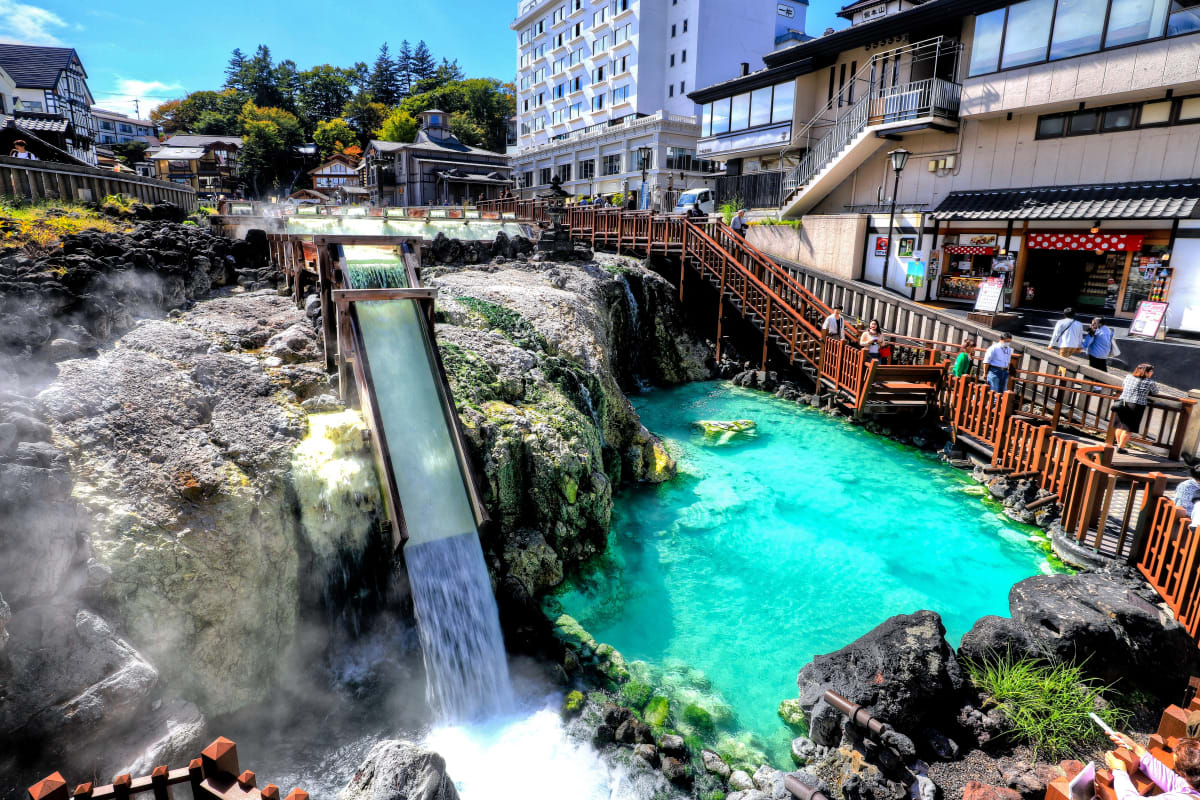
FREEKusatsu Onsen sits at 1,200 meters in the mountains of Gunma Prefecture and ranks among the most celebrated hot spring towns in Japan. The springs here produce more than 32,000 liters of water per minute, a volume unmatched anywhere else in the country. The water is strongly acidic and sulfurous, and its skin-healing properties have long made it legendary among visitors. Twice each day in the central town square, workers cool the scalding water by pulling long wooden paddles through it in unison while singing traditional songs. This practice is called yumomi.
Amenities
Getting there
From Tokyo: Yamagata Shinkansen
Gateway: Yamagata (150 min)
Bus to Zao Onsen (~40 min)
Total journey: 200 min
From Yamagata Station, take the bus to Zao Onsen. The ride takes about 40 minutes.
Location & nearby
Zao Onsen, Yamagata City, Yamagata 990-2301
Make a day of it
Pair your soak with these nearby spots.
Attraction
Genshichi Roten no yu Zao Onsen
0.1km away
Attraction
Zaoonsen Genshichiroten
0.1km away
Attraction
ZaōOnsendairotemburo
0.1km away
Attraction
ZaōOnsen,BāSeiwa
0.2km away
Attraction
Sunokonoyukawaraya
0.3km away
Attraction
KawarayukyōDōYokujō
0.3km away
More springs in Tohoku
Set deep in the Hakkoda Mountains of Aomori Prefecture, Sukayu Onsen is a historic bathhouse best known for its cavernous mixed-bathing hall, the Sen-nin-buro, which translates as the Bath of a Thousand Bathers. The waters are strongly acidic, the setting is rustic and unhurried, and winter brings extraordinary snowfall to the surrounding mountains.

Tsuru-no-yu is the oldest of the seven inns at Nyuto, set deep in a beech forest in Akita Prefecture. The main draw is a large outdoor mixed-bathing pool fed by opaque, milky-white sulfurous water. Many regard it as the most beautiful onsen setting in Japan. People come here to put some distance between themselves and the rest of the world for a while.
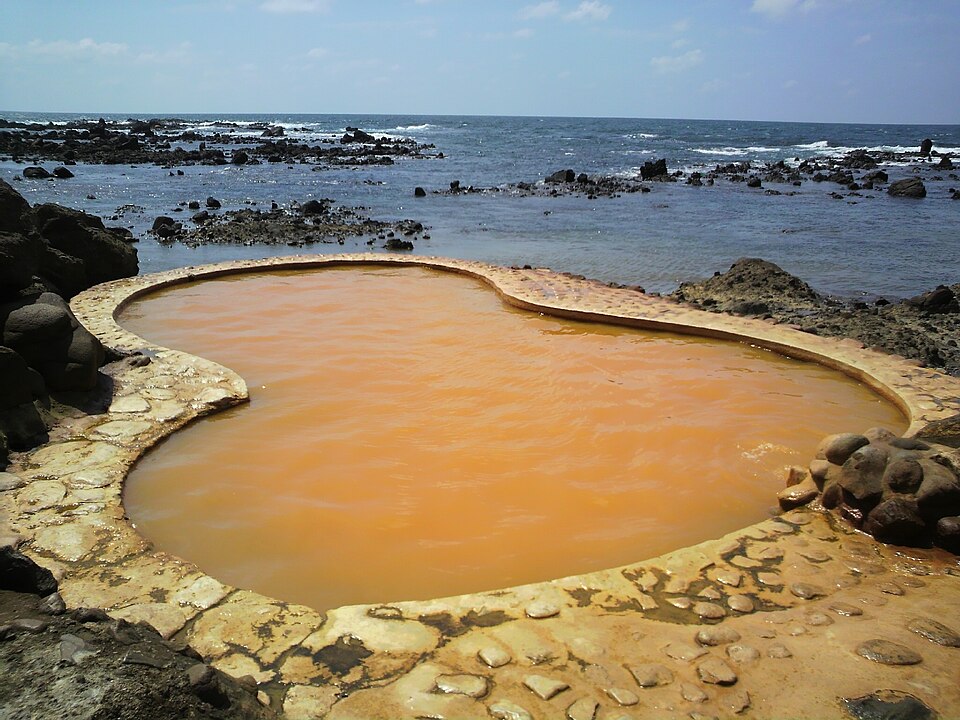
Furofushi Onsen occupies a rocky cape in Fukaura, Aomori Prefecture, with outdoor bathing pools positioned at the edge of the Sea of Japan cliffs. The spring water runs a deep reddish-brown from its high iron and sodium chloride content. The main open-air bath and a dedicated women's pool both use fully undiluted water drawn straight from the source. Sunsets over the water are a particular draw. Once day visitors depart in the late afternoon, overnight guests have the pools to themselves.
Common questions
What is the water temperature at Zao Onsen?▾
The water temperature at Zao Onsen ranges up to 95°C (minimum around 45°C).
Is Zao Onsen free to visit?▾
Zao Onsen charges an entrance fee in JPY.
Is Zao Onsen a public or private bath?▾
Zao Onsen is a public bathing spring.
Are tattoos allowed at Zao Onsen?▾
Tattoo policy varies at Zao Onsen. Check ahead of your visit.
What is the nearest station to Zao Onsen?▾
The nearest station to Zao Onsen is Chuo Ropeway mae, about 0.5km away.