
Kappa-no-yu Hot Spring
元祖かっぱの湯
4.2 · 227 reviews · via Google
Kappa-no-yu Hot Spring
simple-alkaline · Tohoku
Hotter than 20% of Japan springs (n=122).
More acidic than 74% of Japan springs (n=121).
Mineral profile
Bar width reflects listing order, not measured concentration.
Suitability
At a glance
Getting there
Remote — over 5km from the nearest station
Crowd level
Quiet
About this spring
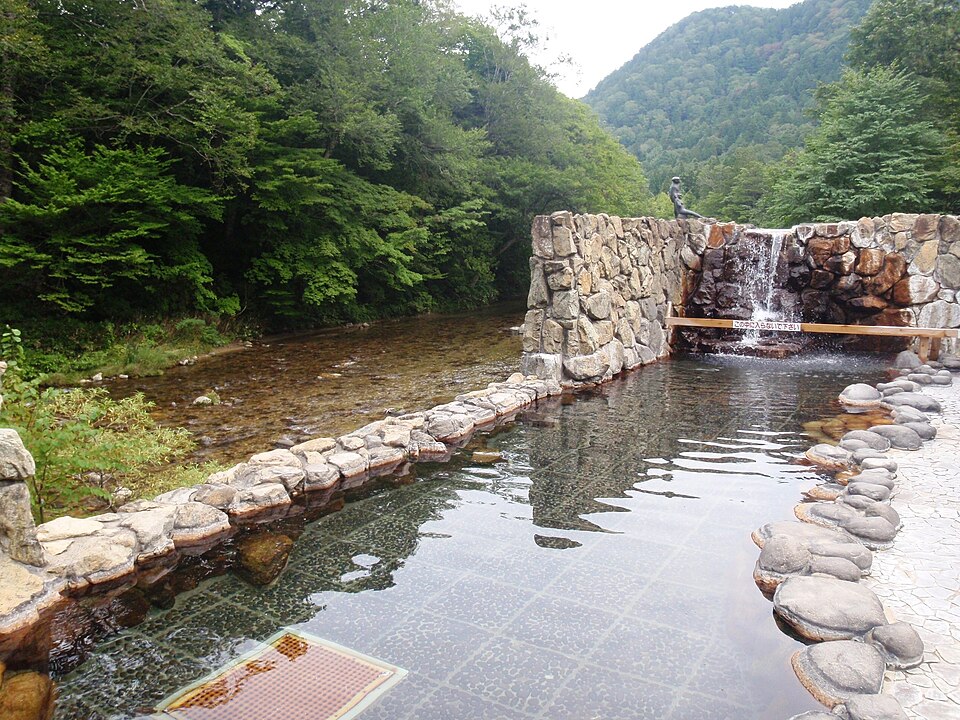
Kappa-no-yu is a free, open-air bathing spot tucked into Yagen Valley on the Shimokita Peninsula in Aomori Prefecture, roughly 2 kilometers up the slope from the central Yagen Onsen cluster. Two separate baths rest beside a clear mountain stream, surrounded by old-growth beech and cypress trees. The water temperature holds at 46 degrees Celsius. Visitors are not permitted to bring soap or shampoo. The baths are open from April through November and charge no entry fee.
Highlights
History
The valley carries a founding legend tied to 1615, when a warrior who escaped northward after defeat at the siege of Osaka Castle is said to have discovered Yagen valley.
An earlier tradition links the upper springs to the Buddhist monk Jikaku Daishi. Around 862 AD, according to the story, a kappa water sprite brought the ailing monk to soak in the spring, where he was healed. The two outdoor baths at that location, called Ganso Kappa-no-Yu and Fufu Kappa-no-Yu, remain there today. The name Yagen derives from the pestle-shaped mortar used in traditional herbal medicine. The V-shaped contour of the valley was said to resemble that implement.
Local guide
There is no public transport to Yagen Valley. That fact alone tells you what kind of place this is. You rent a car in Mutsu City, drive north through the Shimokita Peninsula toward the very tip of Honshu, and the road gets smaller and more hemmed in by beech and cypress the further you go. After about forty minutes of driving through forest that smells of cold creek water and leaf rot, you arrive at a gravel clearing where a handpainted sign and a basic wooden changing shed mark the entrance to Ganso Kappa-no-Yu, which translates plainly as the Original Kappa Bath.
The water emerges from the streambed itself, a weakly alkaline simple spring running at a steady 46 degrees, and it fills two open stone pools that sit right alongside a clear mountain stream. The color stopped me. In bright sunlight the water in the pools carries a faint emerald green, not the milky turquoise of sulfur springs but something clearer and deeper, as if the light is passing through the water differently here. There is no soap, no shampoo, and a sign asks visitors to rinse before entering to protect the stream ecosystem. The admission is free. The silence is so complete that you can hear the current moving in the stream next to you.
The kappa legend attached to this place stretches back to around 862 CE, when a wandering Buddhist priest named Jikaku Daishi fell from a cliff nearby and was found by a kappa, a mythical water sprite of Japanese folklore. According to the story, the kappa dragged the injured priest to this spring, wrapped him in butterbur leaves, and left him to soak until his wounds healed. The priest gave the spring its name when he woke, fully recovered. Local tradition also holds that on nights when a full moon reflects in the bath, an elderly kappa can be seen dancing at the water's edge. Whether you believe it or not, alone in that forest pool at dusk with the sound of moving water on three sides, it does not feel like an unreasonable claim.
The valley is open from April through November. In peak autumn the beech trees above the pools go yellow-gold and drop leaves into the stream. The changing room is basic, there is no heated interior space, and the walk from the car park takes about five minutes on a forest path. Two pools means men and women alternate by schedule rather than bathing together, which the signage makes clear. Get there early in the morning or in the last hour before closing and you will often have the whole valley to yourself.
Mineral chemistry
Alkaline springs (pH above 8) are known for their skin-softening effect, sometimes called "beauty water" in bathing cultures across Asia. The high pH saponifies skin oils, producing a characteristic silky feel on the skin surface.
The slippery feeling underfoot in highly alkaline springs is normal — take care when standing and walking in the bath. Avoid prolonged soaking if you have dry or sensitive skin.
Similar springs
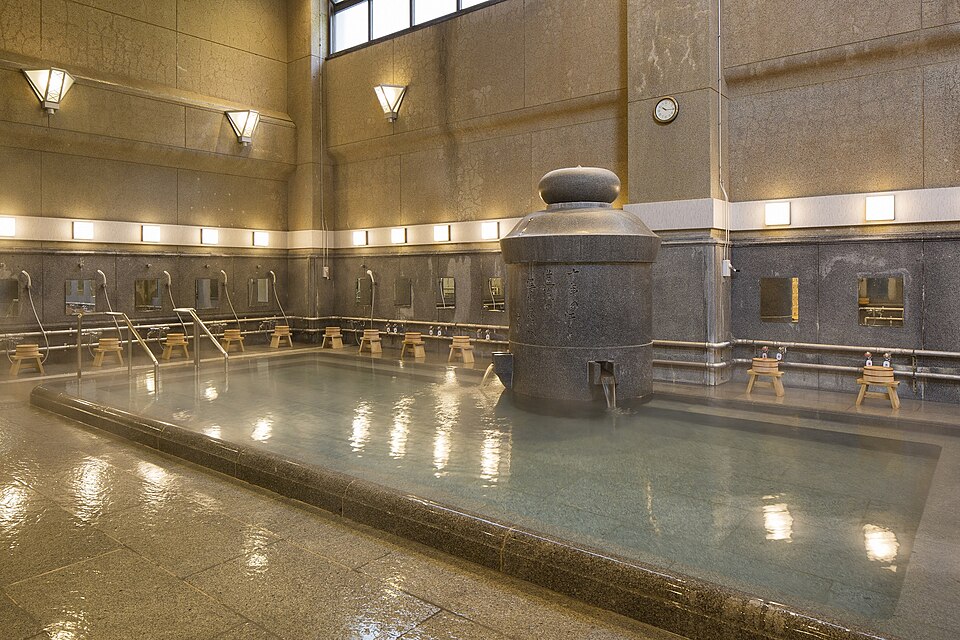
Tsubaki Onsen occupies a single large bathhouse on the Kii Peninsula in Wakayama Prefecture, surrounded by forest and roughly 2.5 hours from Osaka by train. The spring registers pH 9.9, placing it among the most alkaline waters in Japan. The facility is straightforward and well-maintained, attracting visitors from the Kumano region as well as day-trippers traveling in from the coast.
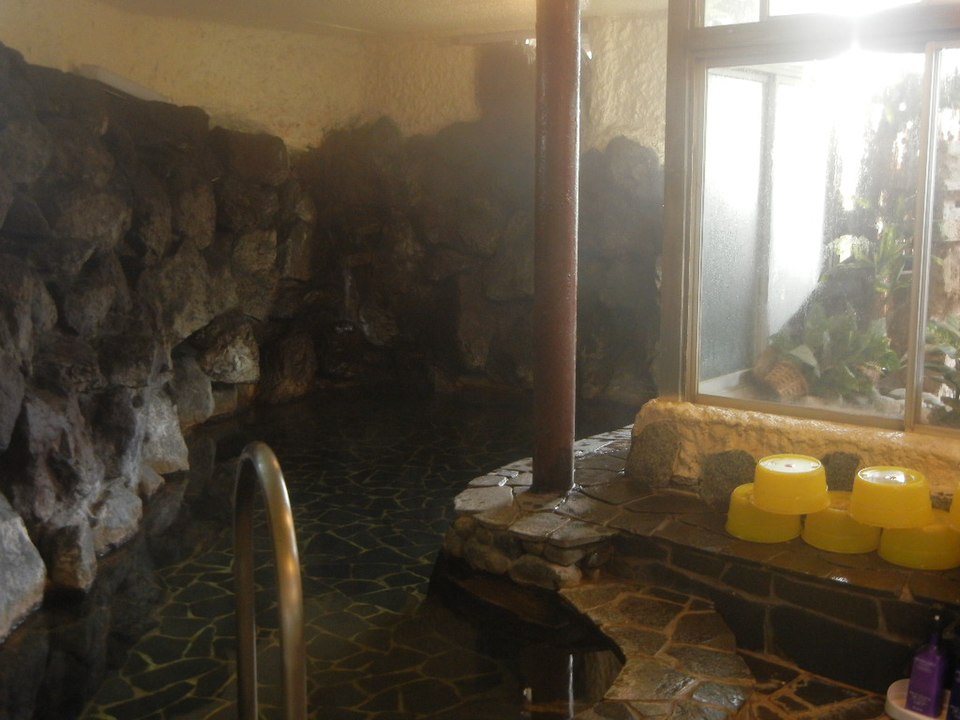
Iiyama Onsen sits in northern Nagano Prefecture near the Nozawa Onsen highlands and produces water with a pH of 11.3, placing it among the most alkaline natural hot springs anywhere in Japan. The soft, high-alkaline water has long been sought out as a beauty spring, widely praised for the way it smooths and softens the skin. The Hokuriku Shinkansen now stops at Iiyama Station, cutting travel time from Tokyo considerably.
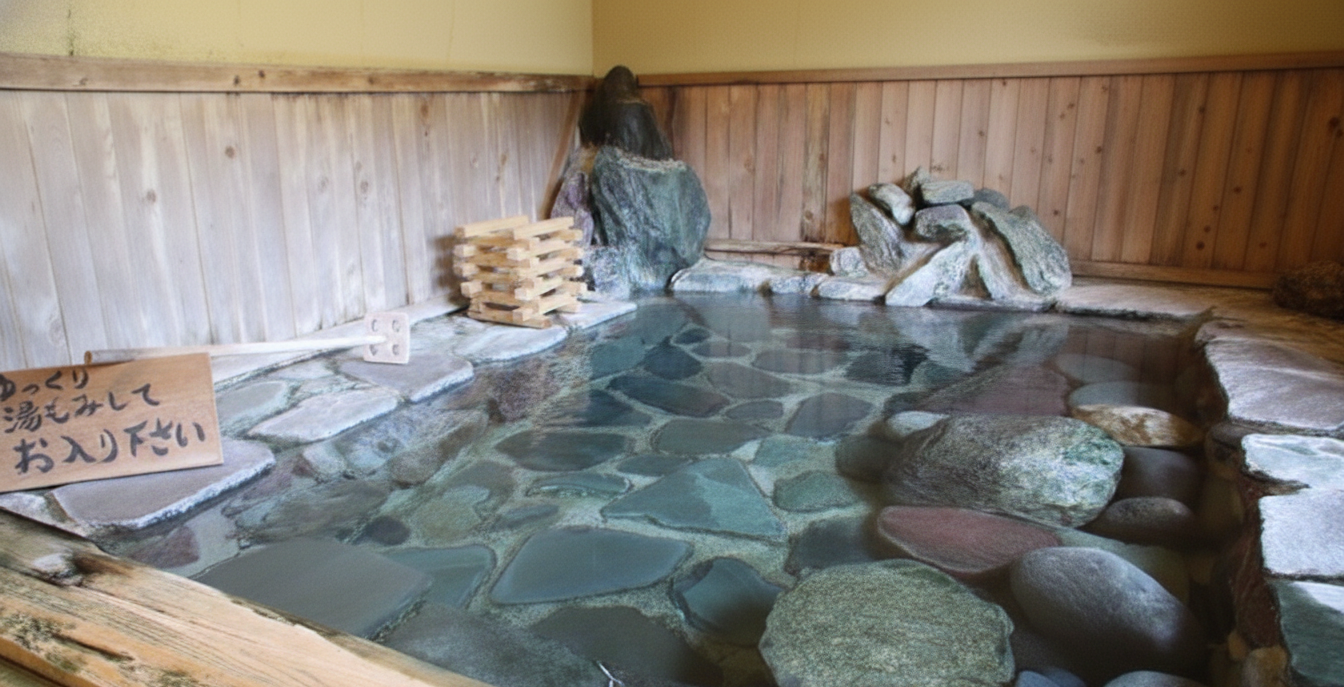
Tokigawa Onsen sits in Hiki District, Saitama Prefecture, roughly 90 minutes from central Tokyo. The water rises from Chichibu Paleozoic strata at a depth of 1,700 meters and registers pH 10, placing it firmly in the highly alkaline range. Bathers consistently note the silky feel it leaves on the skin. The facility has held onto its Showa-era bathhouse character rather than updating it.
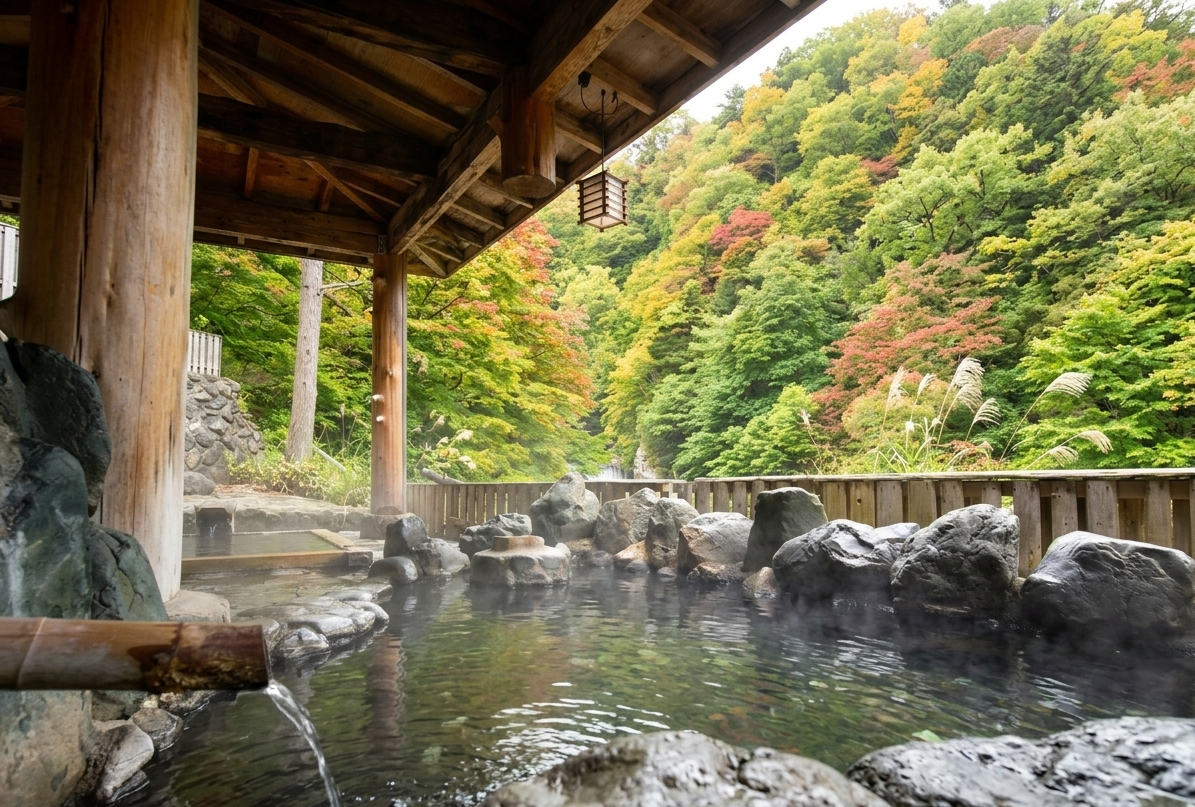
Akinomiya Hot Springs is a cluster of mountain springs situated along the Yakunai River at the western foot of Mount Kurikoma in Akita Prefecture, widely regarded as the prefecture's oldest spring resort. The geothermal area has been catalogued as containing more than 50 individual springs and fumaroles. The innermost of these, Takanoyu, is both the most remote and the most celebrated.
Amenities
Getting there
From Hachinohe, take the Aoimori Railway to Noheji Station, then transfer to the JR Ominato Line to Shimokita Station. Total rail journey from Hachinohe is about 90 minutes. At Shimokita Station, take a bus toward Ohata and then onward to Oku-Yagen. Bus service runs from May through October only. The journey from Shimokita to Oku-Yagen takes about 70 minutes.
Location & nearby
〒039-4401 Aomori, Mutsu, Ōhatamachi, Akatakiyama Kokuyūrin 奥薬研
Make a day of it
Pair your soak with these nearby spots.
Attraction
Okuyagen Onsen
0.1km away
Attraction
Yagenonsen Kappanoyu
0.3km away
Attraction
Uguitaki
0.6km away
More springs in Tohoku

Set deep in the Hakkoda Mountains of Aomori Prefecture, Sukayu Onsen is a historic bathhouse best known for its cavernous mixed-bathing hall, the Sen-nin-buro, which translates as the Bath of a Thousand Bathers. The waters are strongly acidic, the setting is rustic and unhurried, and winter brings extraordinary snowfall to the surrounding mountains.

Tsuru-no-yu is the oldest of the seven inns at Nyuto, set deep in a beech forest in Akita Prefecture. The main draw is a large outdoor mixed-bathing pool fed by opaque, milky-white sulfurous water. Many regard it as the most beautiful onsen setting in Japan. People come here to put some distance between themselves and the rest of the world for a while.
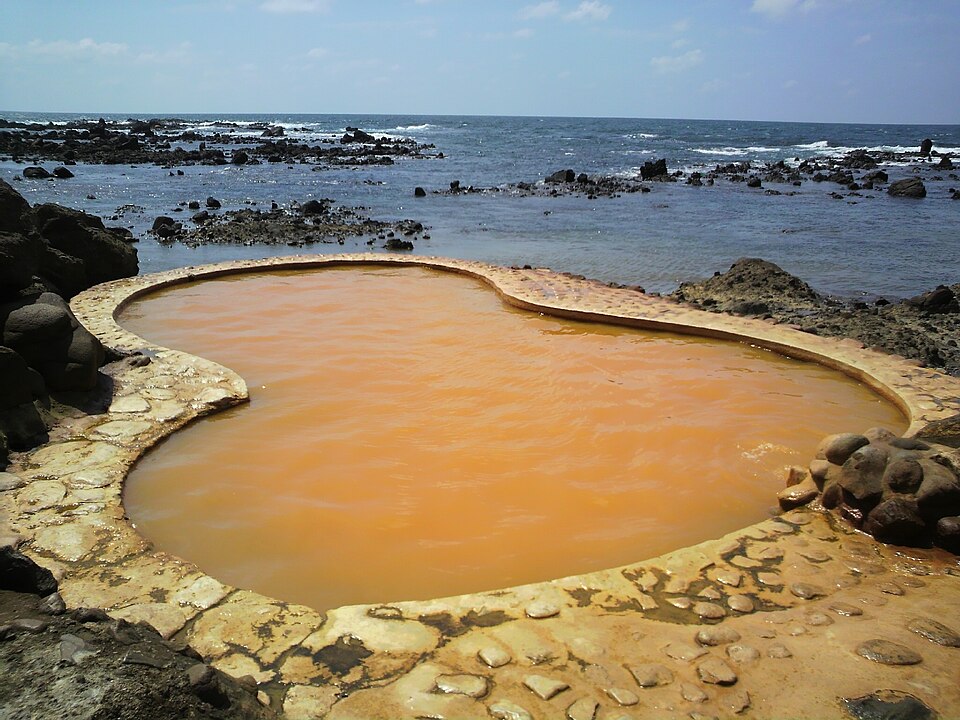
Furofushi Onsen occupies a rocky cape in Fukaura, Aomori Prefecture, with outdoor bathing pools positioned at the edge of the Sea of Japan cliffs. The spring water runs a deep reddish-brown from its high iron and sodium chloride content. The main open-air bath and a dedicated women's pool both use fully undiluted water drawn straight from the source. Sunsets over the water are a particular draw. Once day visitors depart in the late afternoon, overnight guests have the pools to themselves.
Common questions
What is the water temperature at Kappa-no-yu Hot Spring?▾
The water temperature at Kappa-no-yu Hot Spring ranges up to 46°C (minimum around 46°C).
Is Kappa-no-yu Hot Spring free to visit?▾
Yes, Kappa-no-yu Hot Spring is free to visit.
Is Kappa-no-yu Hot Spring a public or private bath?▾
Kappa-no-yu Hot Spring is a public bathing spring.
Are tattoos allowed at Kappa-no-yu Hot Spring?▾
Yes, Kappa-no-yu Hot Spring welcomes visitors with tattoos.
What is the nearest station to Kappa-no-yu Hot Spring?▾
The nearest station to Kappa-no-yu Hot Spring is Osorezan, about 7.6km away.