
SpringsAtlas
Search Hot Springs
All hot springs
241 springs found

Iwaki Yumoto Onsen sits in Fukushima Prefecture and holds an unusual distinction among Japanese hot spring towns: its single underground source pushes out roughly five tonnes of water per minute, a rate that places it among the most productive springs in the country. The water is classified as a sodium chloride and sulfate spring and carries a notable sulfur quality. Together with Arima and Dogo, Iwaki Yumoto is counted as one of Japan's Three Ancient Hot Springs.
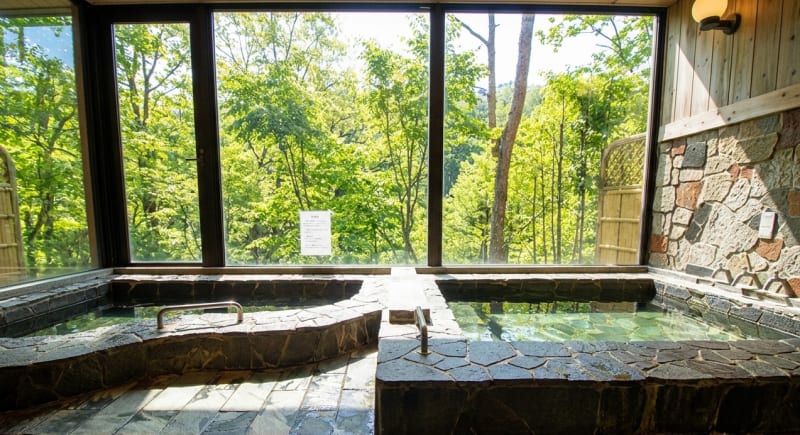
Rosoku Onsen, formally the Yunoshima Radium Mineral Spring Sanatorium (湯之島ラジウム鉱泉保養所), is a radium spring and cure-stay inn in the Takayama district of Nakatsugawa, in the mountains of Gifu Prefecture. The operator describes the water as among the richest in radium in Japan, drawn from several sources on an estate of about 80,000 tsubo (roughly 26 hectares) of forest with a mountain stream and walking paths. The spring is classed as a simple radioactive spring (単純放射能泉), and the operator cites a radon content of 2,020 × 10⁻¹⁰ curie (556 Mache units) measured by a Gifu Prefectural institute. The inn is built around toji, the traditional cure stay: bathing, drinking the water and breathing the radon-rich air, with gentle walks between soaks. Meals favour vegetables from the inn's own pesticide-free farm, river fish and mountain vegetables. Day visitors are welcome on the days the inn is open to them, which the operator publishes each month.

Tucked into a narrow valley in the Kii Mountains, Yunomine Onsen sits along the Nakahechi Trail of the Kumano Kodo pilgrimage route and ranks among Japan's oldest thermal springs, with origins dating back more than 1,800 years. The water is known to shift color seven times throughout the day as temperature and mineral concentration fluctuate. Tsuboyu, a small stone-lined soaking pool enclosed within a wooden cabin, holds the distinction of being the only bathing facility in the world registered as a UNESCO World Heritage Site.

Akayu Onsen is a historic hot spring town in Nanyo City, Yamagata Prefecture, situated along the Mogami River. The thermal waters carry a sulfurous quality and are valued for their warming effect on the body. The name Akayu, which translates as red hot water, comes from a founding legend rooted in 1093, when soldiers serving Minamoto no Yoshie reportedly bathed in the spring after sustaining wounds, and their skin turned visibly red in the water.
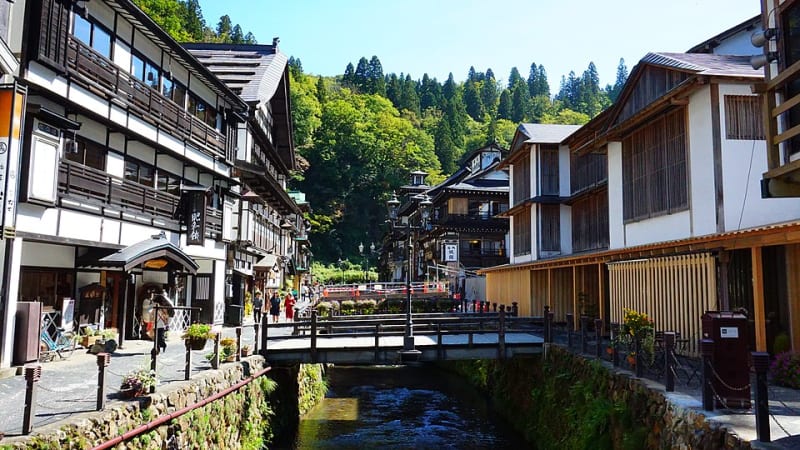
Ginzan Onsen lines the narrow banks of the Ginzan River in Obanazawa, Yamagata Prefecture, a Taisho-era hot spring town where three-storey wooden ryokan stand shoulder to shoulder on both sides of the water. After dark, gas lanterns light the facades, and not a single modern building interrupts the streetscape. At the head of the valley, the Shirogane waterfall drops 22 meters directly into the river.

Shimobe Onsen sits along the Shimobe River in Yamanashi Prefecture, tucked against the base of the Minobu mountains and backed by more than 1,200 years of documented history, making it among the oldest hot spring destinations in Japan. The site is closely linked to the warlord Takeda Shingen, who reportedly sent soldiers here to heal their wounds following the battles of Kawanakajima. The waters are strongly alkaline, registering pH 10.

Awazu Onsen is a compact hot spring resort in Komatsu, Ishikawa Prefecture, established in 718 AD by the Nara-period monk Taich, who was guided to the location by the mountain deity of Hakusan. Roughly a dozen ryokan make up the district, and each property draws water from its own dedicated well, giving it an intimacy that sets it apart from larger Hokuriku destinations. The Hoshi Ryokan, situated within the Awazu district, has been recognized by Guinness World Records as the world's oldest hotel.

Yamashiro Onsen ranks among the largest hot spring resort towns in the Hokuriku region, situated in Kaga, Ishikawa Prefecture. The town counts 31 traditional ryokan and traces its origins back more than 1,300 years. At the center of town stands Kose no Sato Yunodori, a public bathhouse that welcomes day visitors and serves as the communal gathering point of the resort.
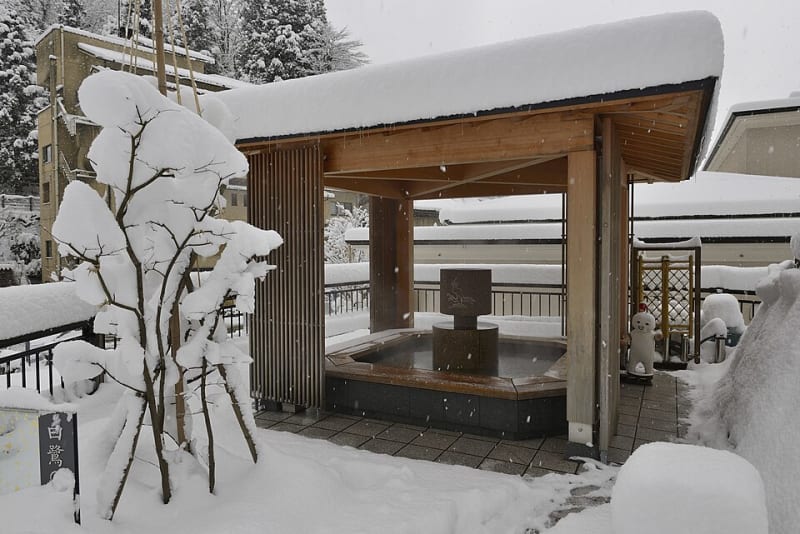
Yuwaku Onsen is a compact hot spring village nestled against the base of Mount Ioh in Kanazawa, Ishikawa Prefecture. The settlement holds nine ryokan along a wooded hillside roughly one hour from central Kanazawa. Its waters are slightly alkaline and carry a gypsum mineral composition, and the area is characterized by quiet forested slopes and subdued mountain views.

Geto Onsen sits deep inside Kurikoma Quasi-National Park in Iwate Prefecture, a mountain hot spring established in 1134 and still very much in its natural state. Seven open-air pools line a rocky riverbed with no enclosing walls, so bathers look straight out into the surrounding forest. The hot water rises directly from the riverbed and its banks. The mountain road is snowed in from mid-November through early May, and the site closes for the season during that period.

A tight lane of flagstone runs through the Yamanouchi district of Nagano Prefecture, lined on both sides by dark timber ryokan with a recorded history stretching back more than 1,300 years. Nine communal bathhouses are distributed through the village, each believed to treat a different ailment, and inn guests may use all of them at no cost. Paper lanterns hang outside wooden storefronts along a streetscape that has gone largely unchanged for four centuries. Just outside town, the Jigokudani snow monkey park draws travelers who combine primate-watching with a stay at this ancient bathing village.

Katayamazu Onsen sits on the shore of Lake Shibayamagata in the Kaga district of Ishikawa Prefecture. The lake is known to pass through seven distinct colors at different points throughout the day. Among the four Kaga Onsen towns, Katayamazu is the youngest, though the broader region carries more than 1,300 years of bathing tradition.

Wakura Onsen sits on the shore of Nanao Bay at the base of the Noto Peninsula in Ishikawa Prefecture, an upscale resort town where the bay water is sheltered and the views stretch broadly across it. The geothermal springs here reach temperatures close to 90 degrees Celsius, so the water must be cooled down before guests can bathe. Around the small town, several public foot baths are available at no charge.

Yamanaka Onsen occupies a mountain setting in Kaga, Ishikawa Prefecture, positioned along a gorge that the Daishoji River has carved through the terrain. Canyon walls rise steeply on both sides, and footpaths run beside the water, giving the town a character that distinguishes it from the other resorts in the Kaga Onsen group. The poet Matsuo Basho passed through in 1689 and recorded his praise for the baths in the travel diary Oku no Hosomichi.
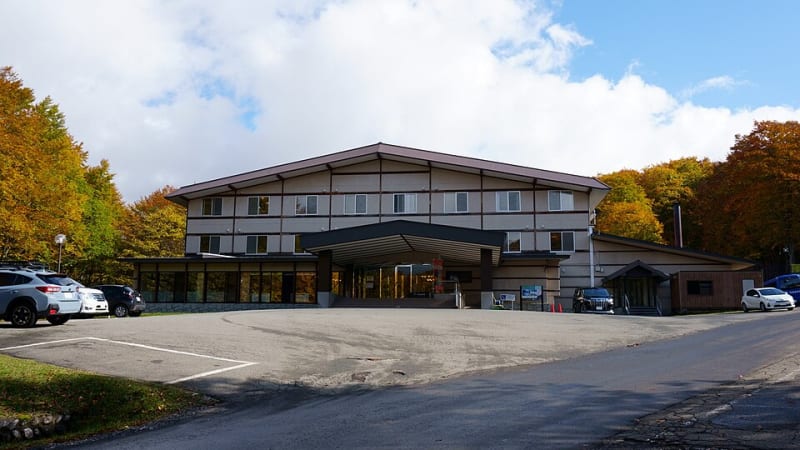
Deep in Towada-Hachimantai National Park, seven small hot spring inns sit among beech forest with few roads connecting them to the outside world. Each inn draws from its own source and has a distinct atmosphere. A pass called the yumeguri-cho covers entry to all seven, letting visitors move between them over the course of a stay. Few onsen groupings anywhere in Japan feel as genuinely remote as this one.
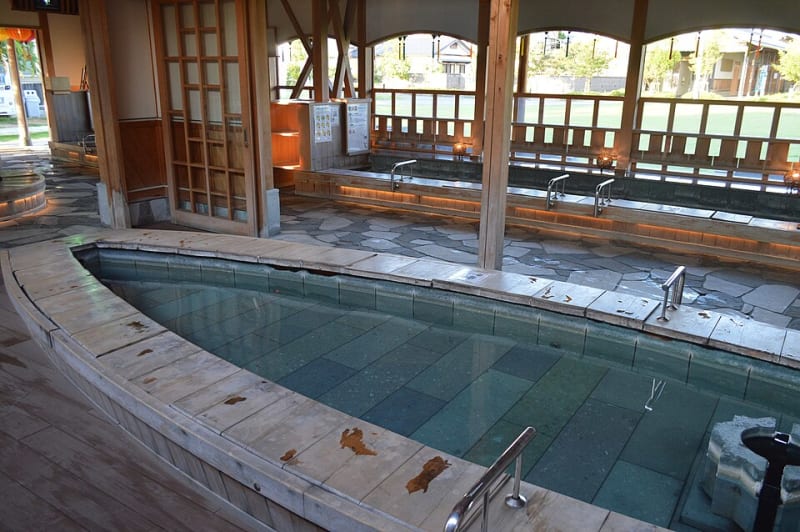
Awara is a hot spring town in Fukui Prefecture, frequently described as the entry point to the Hokuriku region. Its waters run hot and carry a pronounced saline content, and ryokan line the tree-shaded streets in close succession. The town covers a small area and lends itself well to walking, often done in a yukata borrowed from the inn.

Dake Onsen is a hot spring village sitting on the highland slopes of Mount Adatara in Nihonmatsu, Fukushima Prefecture. Its waters are strongly acidic, registering a pH of 2.5. The settlement has endured more than its share of calamity. A massive landslide in 1824 buried the original village, and the Boshin War of 1868 leveled the rebuilt town during combat that included the celebrated last stand of the Nihonmatsu Shonentai, a unit of boy samurai ranging in age from 12 to 17.

Iizaka Onsen sits on the banks of the Surikami River, roughly 10 kilometers northwest of Fukushima city. The resort town holds more than 40 ryokan alongside nine public baths. Its oldest communal bathhouse, Sabakoyu, has operated since at least the 1600s. The Edo-period poet Matsuo Basho stopped here and wrote of the springs.

Takayu Onsen sits at high elevation on the flanks of Mount Azuma in Fukushima Prefecture, roughly 50 minutes from Fukushima city by bus. The springs rank among the most acidic in Tohoku, producing milky white water with a sharp sulfurous smell. The village is recognized as one of the Three Takayu hot springs of the Oshu region, a distinction that has drawn visitors for centuries. Around twelve ryokan are gathered near ten spring sources in surroundings that have seen little change since the Edo period.

Tsuchiyu Onsen sits in the mountains roughly 16 kilometers west of Fukushima city, where the Arakawa River runs along the foot of Mount Azuma. The spring water comes up clear and colorless, carrying only a faint hint of sulfur. The town has a well-regarded kokeshi tradition, producing dolls with proportionally smaller heads and distinctive painted details that developed out of the winter craft work particular to this isolated valley.